
Covering outdoor courts changes three things for a UK tennis club: how much of the winter programme survives the weather, how many players the club can coach, and whether members stay through the dark months. Three clubs that chose Covair domes – in Essex, Edinburgh and north-east London – show what that looks like in numbers.
What does covering courts do to a club’s winter programme?
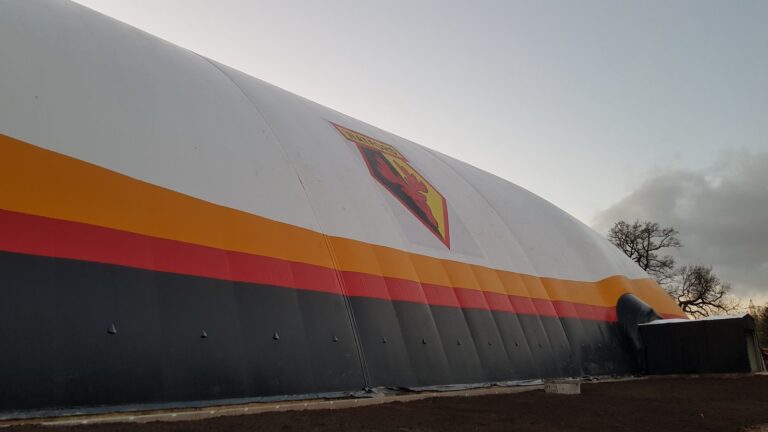
It keeps the programme running. At The Grange Club in Edinburgh, which commissioned a two-court permanent air dome in October 2024, around 80% of the winter programme now runs indoors. Head Coach Calum Meston reports a 75% increase in participation in the club’s coaching programmes since the dome went up, and the club has taken on more coaches to meet it.
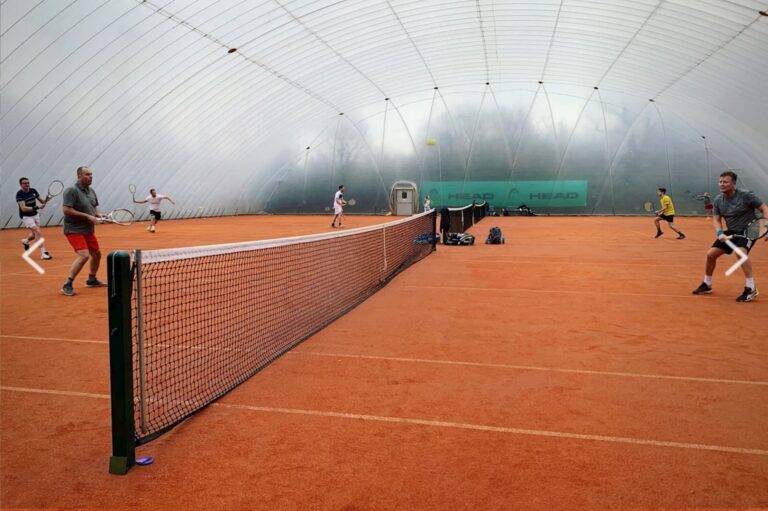
At Billericay Lawn Tennis Club in Essex, coaching programmes used to lose nearly a third of their sessions to bad weather, despite all-weather courts. Two seasonal air domes over five of the club’s ten floodlit courts ended that disruption.
“Being able to guarantee quality training sessions and not fighting on through the bad weather is a massive win for the coaches and club members.”
Rebecca Wright, Head of Junior Tennis, Billericay Lawn Tennis Club
Do members stay through the winter?
At Billericay they do more than stay. The club has more than 600 members and around 400 juniors aged three to eighteen, and winter has gone from its most disrupted period to one of its busiest.
“Before Covair, we didn’t have any meaningful winter membership. But that’s all changed … Members usually leave during the winter, but our membership actually grows.”
Lester Galley, Chairman and Director, Billericay Lawn Tennis Club
At Chingford School of Tennis the change shows up as availability. A second dome, added in June 2025, took the club from three indoor courts to six, and evening and weekend court time is now easy to find.
Seasonal or permanent – how did each club choose?
Each club was answering a different question, which is why each ended up with a different structure.
| Club | What they installed | Covered | When it is up | What it was for |
|---|---|---|---|---|
| Billericay Lawn Tennis Club, Essex | Two seasonal air domes | 5 of 10 courts | October to late March or early April | Winter coaching and membership, at seasonal cost |
| The Grange Club, Edinburgh | Permanent air dome to LTA specification | 2 courts | All year, since October 2024 | A performance pathway and a community programme |
| Chingford School of Tennis, London | DUOL double-skin permanent air dome, alongside an existing Covair dome | 3 more courts, 6 indoor in total | All year, since June 2025 | Capacity – more players, more events |
Billericay’s case is the economic one. Its domes go up each October and come down in spring, so the courts are outdoor courts all summer. Seasonal air domes start from £85,000; permanent air domes from £150,000.
“There’s a strong economic argument for seasonal air domes. You could easily spend much more on permanent structures, but then you’d have the worry about recouping the investment.”
Lester Galley, Billericay Lawn Tennis Club
The Grange’s case is performance. Its dome was built to LTA specifications with LTA funding – generous run-backs, a ten-metre apex, and lighting mounted above the run-backs rather than over the courts – so juniors on ITF, LTA and National Academy pathways can train on an indoor acrylic court at home.
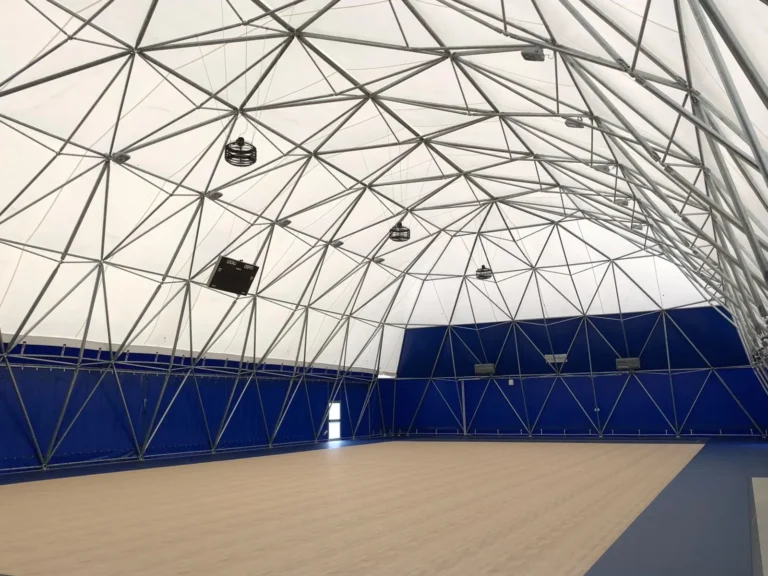
Chingford’s case is capacity. The club already had a Covair dome over three courts. When levelling-up funding for community spaces in the London Borough of Waltham Forest opened the door to an upgrade, it added a double-skin DUOL permanent dome over three more.
What can six indoor courts do that three cannot?
Host events. With six covered courts, Chingford staged its first Grade 4 LTA tournament, with around 200 entrants over the week, and can now run it every year alongside one-day Grade 4 and 5 tournaments for juniors and adults. Universities book daytime courts, local schools run inter-school tournaments, walking tennis has grown and pickleball has arrived.
The Grange found the same versatility. Junior cricket, girls’ cricket, pickleball and junior movement classes have all run inside its dome, and more than 200 schoolchildren took part in tennis sessions there in a single year.
Will a dome stand up to a UK winter storm?
The Grange had an early test. Weeks after its dome went up, Scotland was hit by its first red-warning storm in more than a decade, and the dome stood firm. Its curved profile lets high winds travel up and over the structure, and constant internal air pressure holds its shape through the gusts.
What should a club decide before it asks for a price?
- What the courts are for. More coaching hours, a performance pathway, or capacity for events and lettings. Billericay, The Grange and Chingford each started from a different answer.
- Seasonal or year-round. A seasonal dome keeps summer tennis outdoors and costs less; a permanent dome gives the same covered courts every day of the year.
- Who looks after it. A seasonal dome needs taking down in spring, storing and re-inflating in autumn; every dome needs servicing. Covair’s DomeCycle and DomeCare services cover both.
- How it is paid for. The Grange had LTA funding; Chingford’s upgrade came through its local authority. DomeFinance offers leasing and hire purchase for clubs that would rather spread the cost.
Covair has covered sport in the UK since 1982, with more than 200 installations across the UK. As the UK’s only manufacturer of air domes and the exclusive UK distributor of DUOL domes, we can recommend seasonal, permanent or framed – whichever fits the club.
Read the full stories from Chingford School of Tennis, The Grange Club and Billericay Lawn Tennis Club, see our guide to covering tennis courts, or talk to us about your courts.