A seasonal air dome gives a club covered courts from autumn to spring and outdoor courts all summer. It works best when the club runs it as a calendar rather than a one-off: inflation in October, checks through the winter, a careful dismantle in spring, dry storage over the summer – and, every ten years or so, a decision about the membrane itself. This is what each part of that calendar involves, and who does what.
When does a seasonal dome go up, and when does it come down?
Most seasonal domes cover their courts from October to March or April. The dates are usually set by the club’s planning consent, which for a seasonal dome runs for part of each year rather than all of it.
“We have planning permission for six months each year, so they go up in October. Then they come down either the last week in March or the first week of April.”
Lester Galley, Chairman and Director, Billericay Lawn Tennis Club
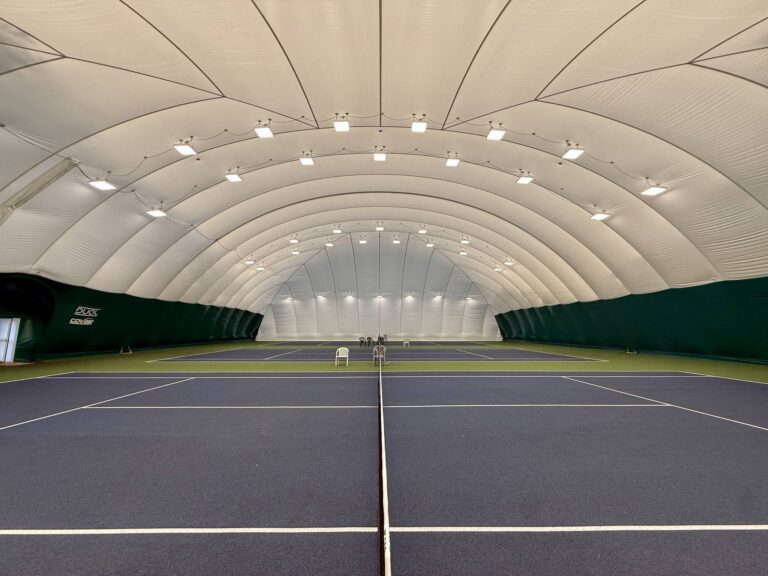
At Billericay Lawn Tennis Club in Essex, two Covair seasonal domes cover five of the club’s ten floodlit courts on exactly that cycle, and have done since 2013. Installation takes three to four days, so the switch from outdoor to covered tennis costs the club very little court time. Over the summer the dome stays on site, stored in a 40ft container or a 50m² shed.
What does the season look like, month by month?
| When | What happens | Covair service |
|---|---|---|
| October | Pre-inflation inspection, controlled inflation, commissioning of fans, controls and emergency systems, handover | DomeCycle |
| November to February | Fans hold the pressure; servicing, mid-winter membrane checks and emergency response as the package provides | DomeCare |
| March or April | Depressurisation, careful folding, inspection of every component, minor repairs | DomeCycle |
| Summer | Stored on site; repairs made off-season; cleaning; a re-cover survey if the membrane is ageing | DomeCycle, DomeClean |
What happens at the autumn inflation?
The dome is checked before it is inflated, not after. Under DomeCycle, Covair’s team inspects the membrane and components, inflates the dome under control, then commissions it: every mechanical and electrical system is verified and the emergency protocols are checked before the club is handed its courts back.
The club’s part is mostly diary work. Transition dates are agreed around the sporting calendar, and a seasonal dome runs on a single-phase 240v supply, drawing 2.5-7.5kW depending on its size, so the power it needs is modest and predictable.
What does a dome need through the winter?
Very little day to day, and the right checks at the right time. Low-energy fans hold the internal air pressure constant and an automatic pressure control does the rest. When severe weather threatens, the rapid deflation system allows a seasonal dome to be taken down completely in under four hours.
What a club adds on top is servicing. DomeCare comes in three levels, each with a guaranteed emergency response time:
| Package | What it adds | Price |
|---|---|---|
| Bronze | Yearly M&E check, blower servicing, control panel, anemometer and emergency systems check, annual inspection report | From £550 |
| Silver | Everything in Bronze, plus a mid-winter membrane condition assessment, cable, door and anchor inspection, and proactive part replacement | From £1,200 |
| Gold | Everything in Silver, plus regular condition reports and 24/7 emergency support with same-day response | From £1,500 |
Prices depend on the dome type and location. Bronze is designed for seasonal installations; Silver and Gold for facilities that want more frequent care and faster response.
What happens when the dome comes down in spring?
The spring dismantle decides the condition of next winter’s dome. DomeCycle depressurises the dome systematically and folds the membrane using techniques that avoid creasing and stress points. Every component is inspected on the way down, any concern is written up, and minor repairs are included in the service.
That timing matters. A problem found in April can be repaired during the storage months at a sensible cost, instead of becoming an emergency fix in the middle of the playing season. Each transition is documented, so the club builds a service history that supports warranty claims and budget planning.
Cleaning belongs in the same cycle. Algae, moss, pollution and bird droppings degrade a membrane as well as dulling it. DomeClean uses low-pressure equipment and biodegradable agents made for dome membranes, restoring light transmission and helping the fabric reach its full working life.
How long does the membrane last?
With proper maintenance, a polyethylene membrane lasts 10-15 years and a PVC membrane 20-30 years. Everything under the membrane – the anchors, the doors, the fans and controls – is built to last far longer.
The signs that a membrane is nearing the end are visible from the court: noticeably less daylight coming through, fading or discolouration, wear along the seams and cable lines, and fabric that has lost its tension. If a dome is more than ten years old and showing any of them, it is worth a survey.
When should a club plan a re-cover?
Well before the October it is needed. Re-covering replaces only the membrane and keeps the anchoring, doors and equipment the club already owns, so it costs a fraction of a new installation. Manufacturing a seasonal dome takes four to six weeks, and a new one is ready 8-12 weeks from order, so a survey over the winter leaves the club time to decide, order and be ready for the following season without a rush.
A re-cover is also the moment to upgrade: from polyethylene to PVC for a longer life, or to add club colours and logos. Covair re-covers air domes whether or not it supplied them.
“Our tennis club purchased their first dome in 1988. We now have 3 Covair domes, which we use during the winter months.”
Wayne Lee, Grounds Secretary, Harpenden Lawn Tennis Club
How do clubs pay for a dome or a re-cover?
Many spread it. DomeFinance offers leasing, hire purchase and seasonal payment structures. New seasonal air domes start from £85,000, with installation included and groundworks priced separately.
Covair has manufactured air domes in the UK since 1982 and has more than 200 installations across the UK. We are the UK’s only manufacturer of polyethylene air domes, and our own British service teams stand behind every one.
Read how Billericay Lawn Tennis Club runs its winter, see covered courts for tennis clubs, or talk to us about your dome.