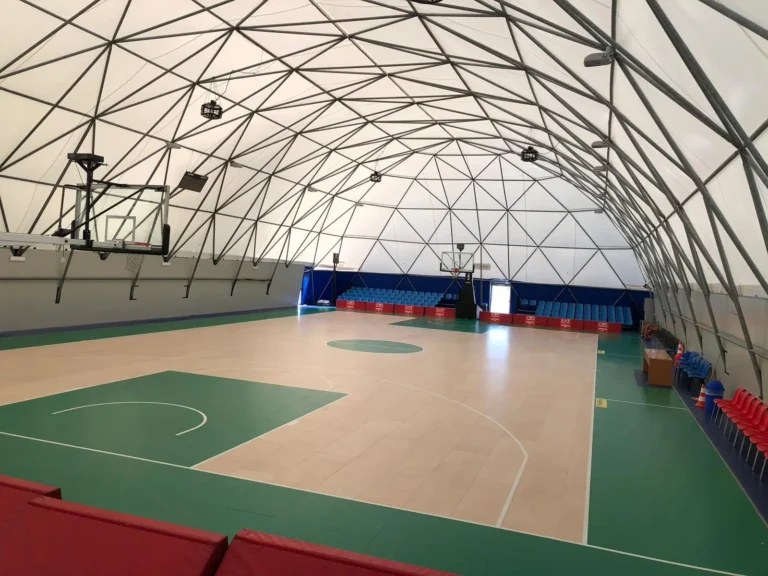
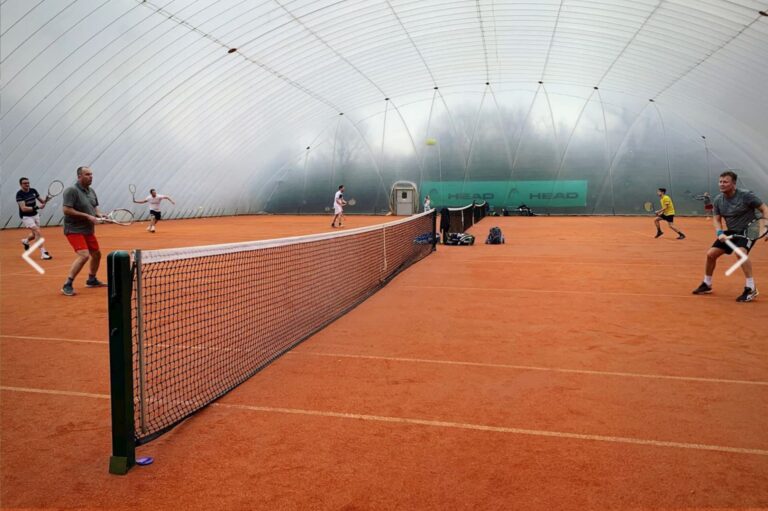
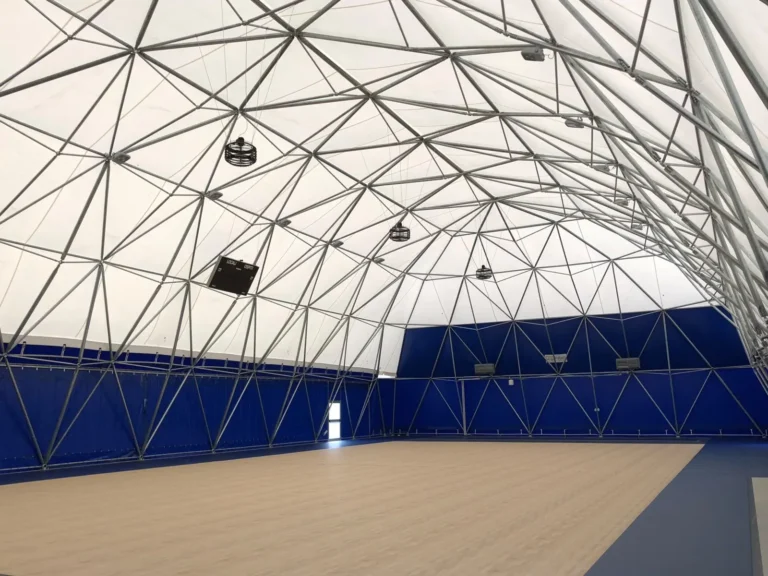
In a named storm, a well-run air dome does three things on its own: it raises its internal pressure as the wind rises, it switches to a standby fan if the duty fan stops, and it keeps its fans running on reserve power if the mains fails. The club’s job is to make sure those systems have been tested before the storm arrives, and to follow a short, written procedure while it passes. This is what that looks like in practice, starting with a dome that was tested by a red warning in its first winter.
What happened at The Grange when the red warning came?
The Grange Club in Edinburgh, founded in 1832, opened its two-court Covair permanent air dome in October 2024. It measures 30.9m x 37.8m, was built to LTA specification with LTA funding, and has a ten-metre apex over generous run-backs. Weeks after it went up, Scotland had its first red-warning storm in more than a decade.
“The dome’s curved profile let high winds travel up and over the structure, reducing surface pressure. Its constant internal air pressure also helped it hold shape during those severe gusts. This allowed the storm to pass around it rather than pushing against it.”
Rick Symington, Chair, The Grange Club
The dome stood firm, and the club now runs around 80% of its winter programme indoors. For a club whose winters used to be shaped by the forecast, that is the point of covering the courts.
Why does an air dome stay up when the wind rises?
Because it is held up by air pressure, and that pressure goes up with the wind. An air dome has no rigid frame to catch the wind. Its fans hold a steady pressure inside the membrane, the cables and anchors spread the load into the ground, and the low curved shape sends moving air up and over the top.
The control system does the rest. An anemometer measures the wind at the site, and as the speed climbs the controls raise the inflation pressure automatically, so the membrane stays taut through the gusts. The LTA’s guidance for air-supported structures sets the same principle: pressure matched to wind speed up to the design wind speed, an alarm inside the dome if the wind passes 75% of that design speed, and a single manual switch that takes the dome straight to full design pressure if staff need it.
What keeps the air on if a fan or the power fails?
A second fan and a reserve power supply. Covair’s domes run with a standby fan that starts automatically if the duty fan stops. If the mains goes down, a reserve supply keeps the fans, controls and emergency lighting running. The LTA guidance asks for that reserve to be able to hold full design pressure for at least 14 hours.
These are the systems that matter most in a storm, and they only help if they work on the day. Our air dome maintenance guide puts it plainly: a blower that fails in a storm, or an anemometer that fails to raise the pressure, is the avoidable incident every operator should plan against.
What should a club do when a named storm is forecast?
Follow a written procedure, in three stages: when the storm is forecast, when the wind reaches the alarm level, and after it has passed. The steps below follow the LTA’s procedure for high winds.
| When | What the club does |
|---|---|
| Storm forecast | Fill the reserve generator’s fuel tank. Check every emergency door is shut and secure and nothing is leaking air. Clear loose objects from within about 1.5m of the membrane, inside and out. Be ready to lower the lights. |
| Wind reaches the alarm level (or 75% of design wind speed) | Clear the dome and keep people away from it. Check the standby fan is running and the pressure is at design level. Lower the lights and lay remaining equipment flat. Watch and log wind speed and pressure from a safe distance. |
| After the storm | Carry out a full inspection, equivalent to the daily, weekly and monthly checks together, before play resumes. |
None of this is complicated, but it has to be known before the night it is needed. Every dome should have at least two members of staff trained on its control panel, and the supplier’s emergency number displayed where the duty manager can see it.
Is a seasonal dome any different?
It has one more option: it can come down. A seasonal air dome runs on the same pressure control and standby fan as a permanent one, and it can also be fully removed in under four hours. If a severe storm is forecast, a club can take that decision early and have the membrane safely down and stored before the wind arrives, then re-inflate when it has passed.
A permanent air dome stays up and rides the storm out. The DUOL permanent domes Covair installs in the UK are wind-rated to 180mph (290km/h).
What should be checked before storm season?
The storm systems themselves: fans, controls, anemometer, emergency systems, doors and anchors. Each DomeCare package covers part of that list, with a guaranteed emergency response time.
| DomeCare package | Storm-relevant checks | Emergency response |
|---|---|---|
| Bronze, from £550 | Yearly M&E check; control panel, anemometer and emergency systems check; blower unit inspection and servicing | 36 hours (PVC domes) |
| Silver, from £1,200 | All of Bronze, plus a mid-winter membrane condition assessment and cable, door and anchor inspection | 24 hours (PVC domes) |
| Gold, from £1,500 | All of Silver, plus monthly preventative M&E visits (PVC domes) and proactive parts replacement | 24/7 support, same-day response |
The most useful single test is the simplest: run the standby fan and the reserve supply on their own, under still conditions, and confirm the pressure holds. If that has not been done since the dome went up in the autumn, it is worth doing before the first named storm of the winter.
How strong a wind is a dome designed for?
The figure that matters is the one for your dome on your site. Covair’s structures are engineered to British and European standards, BS EN 13782 and the Eurocodes, and the design wind speed for a given dome depends on its size, shape and exposure. The certified figures for your product and site come from Covair’s technical team as part of the proposal, and they are the numbers your procedure’s alarm and trigger settings are built on.
For clubs in exposed places, The Grange is the reassurance: a dome in its first weeks, Scotland’s first red warning in more than a decade, and a dome that stood firm. Covair has been building and servicing air domes since 1982, with more than 200 installations across the UK, and our own British service teams look after them through the winter.
If you run a dome, or are planning covered tennis courts, and want your storm procedure, settings and servicing checked before the winter, talk to our team. Protect the asset. Extend the life. Keep the game on.