The price of covering padel courts comes down to six decisions: how many courts, whether they exist yet, which structure, what happens at the sides, what the site allows, and when you want to play. Settle those first and the first figure you are given is one you can build a business case on. This is what each decision involves, and what it changes.
Why cover padel courts at all?
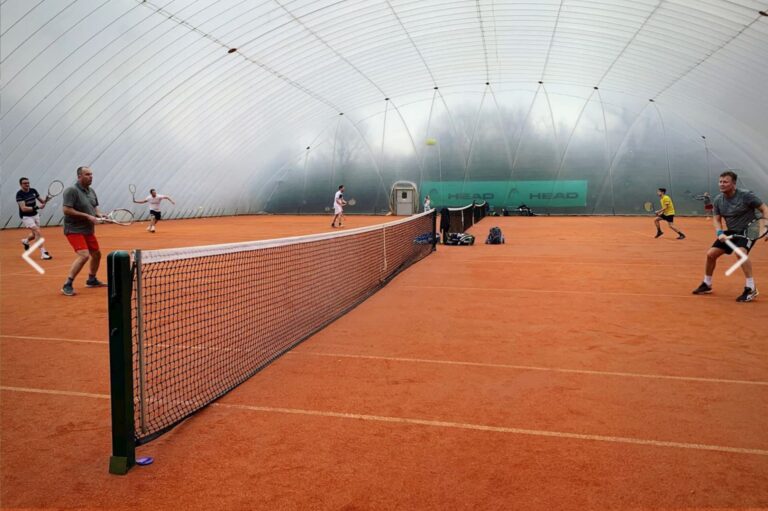
Because UK weather takes half the year away from an open court. Rain on the glass walls makes the game unsafe and drives cancellations, wind spoils the ball flight and cold keeps casual players at home. An uncovered court in the UK earns for roughly six or seven months of the year; a covered one earns for twelve. The UK passed 1,000 padel courts by mid-2025, according to LTA data; cover is what keeps those courts earning in November.
1. How many courts – and do they exist yet?
Start with the number of courts and whether you are covering courts you already have or building new ones under a new structure. Both are common, and they are priced differently.
A padel court is 20m by 10m. The structure over it needs clear height for lobs – at least 6m over the whole court, with 7-8m recommended – plus run-off at the sides and behind the back glass. Covair’s purpose-built compound curve structure covers a single court on a 13m by 23m footprint and two courts on 23m by 23m, and scales to four courts and more. If the courts are already down, the survey checks the space around them, the ground and the access before anything else.
2. Which structure suits the venue?
For padel, Covair’s range is built on the framed fabric structure. It gives the height the game needs, keeps the social, open atmosphere padel players like, and runs with no fans and no ventilation costs. Covair offers three families.
| Structure | What it is | Best for |
|---|---|---|
| Compound Curve | Purpose-built for padel, with an 8-11.5m apex, panoramic viewing and sliding curtains | Dedicated padel operators and tennis clubs adding padel |
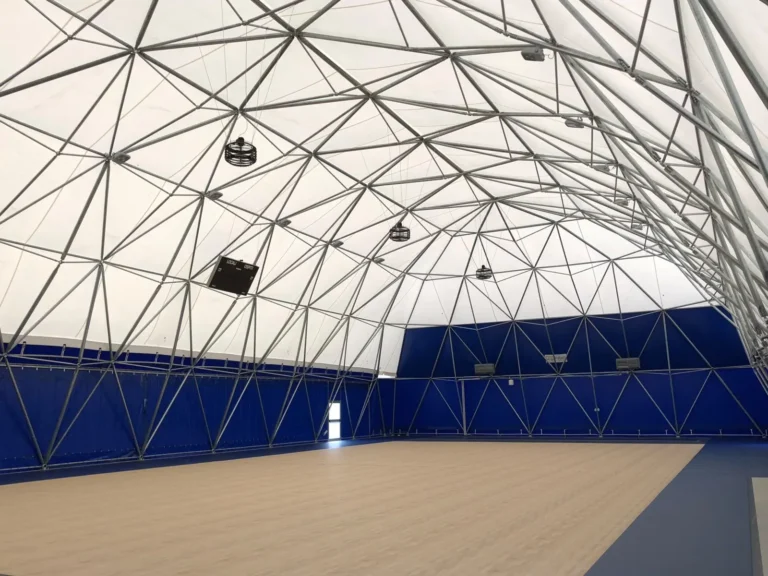
| Geodesic | Bolted steel frame spanning up to 100m without internal supports, with a 40-year structural design life | Larger multi-court venues that want architectural presence |
| Classic Arch | Hot-dip galvanised steel arch, or timber arch in glulam | Clubs testing demand, community venues and phased projects |
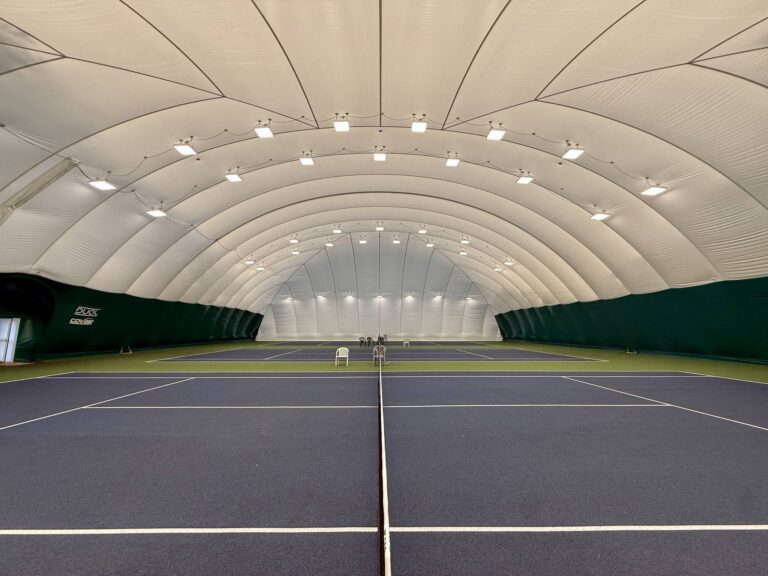
If you want fully enclosed courts, an air dome is the other route: seasonal air domes start from £85,000 and permanent air domes from £150,000. Because Covair supplies both, the recommendation follows the venue rather than the product.
3. Open, curtains or solid sides?
Every one of the three structures comes with a choice of sides, and the choice shapes both the playing conditions and the price.
- Open canopy – a roof over the courts and air all round. Rain protection with the most open feel.
- Sliding curtains – open in summer, closed in winter, motorised or manual. Natural ventilation keeps the glass clear.
- Solid sides – fixed panels for a fully enclosed court, with heating possible where it is wanted.
Hybrid combinations work too, set by the site’s orientation and exposure.
4. What does the site allow?
A permanent structure needs full planning permission, and for padel the questions are predictable: visual impact, light spill from evening play, traffic and parking – and noise. The sound of the ball on the glass is the most common planning objection to padel, so it is worth addressing in the application from the start. Planning typically takes two to four months, so it belongs early in the programme, not at the end.
Groundworks depend on ground conditions and access, which is why they are priced per site after a visit rather than guessed at the start.
5. When do you want to play?
Work back from the opening date. A framed structure typically takes 12-24 weeks from order, depending on complexity: six to eight weeks of fabrication, four to eight weeks of groundworks, and 10-20 days of assembly on site. Add planning, and the useful time to decide is the autumn and winter before the season you want to open for.
6. What will it cost, and how is it paid for?
Covair’s framed fabric structures for padel start from £72,500. The figure moves with the structure chosen, the size and number of courts, the sides, lighting and features, and the site. The courts themselves, groundworks and any clubhouse or changing space are separate budget lines.
Most projects combine more than one source of money. DomeFinance offers leasing, hire purchase and business loans on the structure, the LTA and Sport England support padel facilities that grow participation, and padel’s revenue model has drawn private investment. Our padel cost guide sets out the full budget.
What should you send when you ask for a price?
- The number of courts: one, two, or three and more.
- New build, or courts you already have.
- Open, curtains or solid sides – or “not sure yet”.
- Where the site stands: owned or leased, and whether planning has been discussed.
- When you want to be playing.
With those five answers we can recommend a structure and give an indicative figure, then visit the site to firm it up.
Covair has covered sport in the UK since 1982, with more than 200 installations across the UK, and supplies both framed fabric structures and air domes for padel from one team. See covered padel courts, read our guide to planning a covered padel facility, or send us your five answers.