
For a growing number of football clubs, covered training has moved from a luxury to an expectation. The EPPP framework points academies towards indoor provision, Football Foundation funding has made projects viable further down the pyramid, and the run-up to Euro 2028 is keeping facilities high on the agenda. For most clubs the question is no longer whether to cover a training pitch, but how.
Two routes dominate that decision: an air-supported dome, or a steel-framed permanent building. Both deliver year-round training space. They do it in very different ways, at very different price points and timescales. This guide sets out how they compare, and when each is the right call – from a manufacturer that supplies both, plus framed fabric structures, so the comparison is an honest one rather than a pitch for a single product.
The two routes, briefly
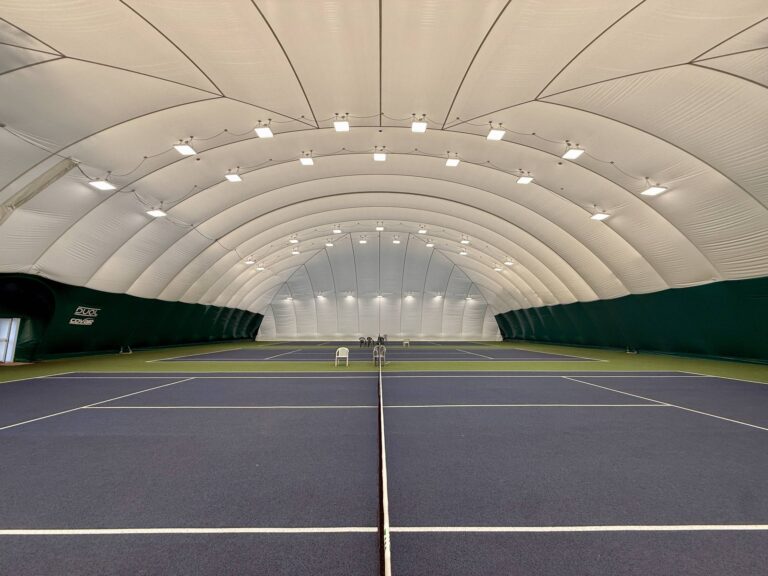
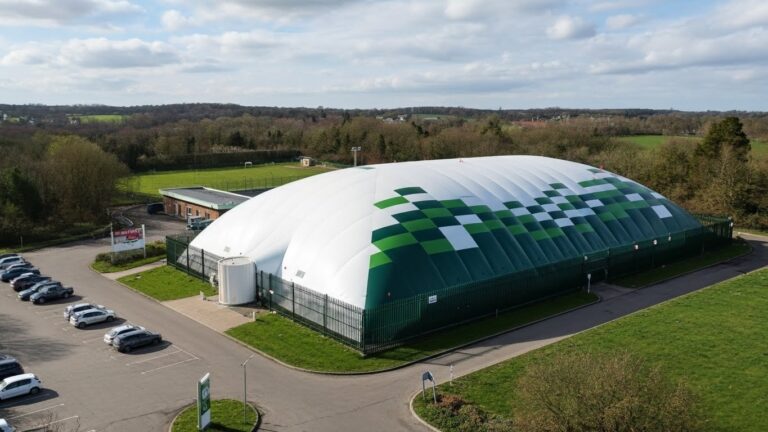
Air domes. An air-supported dome is held up by gentle internal air pressure rather than a frame. There are two types. Seasonal domes go up for the winter and come down in summer, preserving outdoor play and an outdoor character; they are the entry point, from £85,000. Permanent domes stay up year-round and add climate control, premium insulation and professional lighting; specified well, they deliver elite training conditions from £150,000.
Steel-framed buildings. A traditional indoor facility – a portal-frame or steel-framed hall with a solid or fabric roof – is a permanent structure on conventional foundations. It offers a fixed, robust, year-round space with uniform light and no reliance on air pressure, at a capital cost and build time closer to traditional construction.
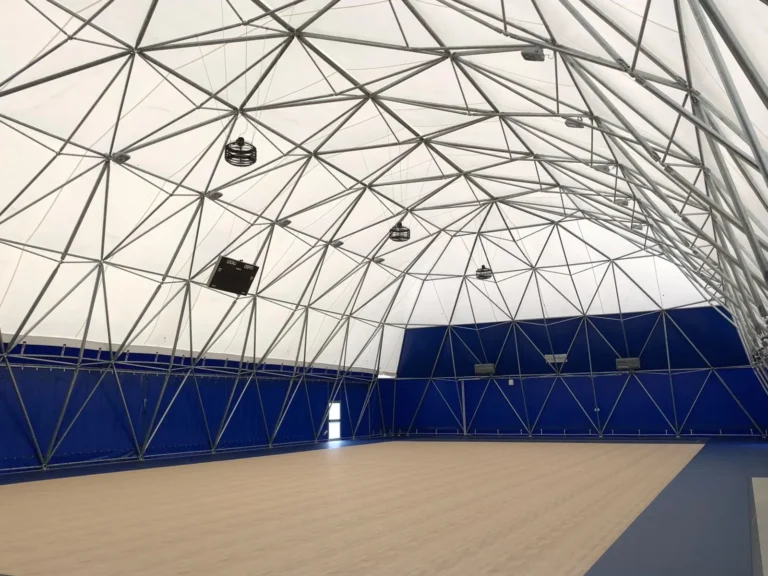
There is a third route worth knowing about: framed fabric structures – steel or timber arches with a tensioned membrane and open or curtained sides. They sit between the two, pairing a permanent frame with the speed and openness of a fabric roof. Covair supplies these too, which is why the rest of this guide compares solutions rather than suppliers.
How they compare
Speed of installation. This is the starkest difference. A seasonal dome is operational in three to four days; a permanent dome in seven to ten. A steel-framed building is a construction project measured in months, with groundworks, steel erection and fit-out. For a club protecting a training programme through one winter, or trying to be facility-ready before an audit, weeks versus months matters.
Capital cost. Air domes start lower – from £85,000 for a seasonal dome and from £150,000 for a permanent one – against the higher outlay of a permanent building of comparable footprint. For clubs in the Championship and below, where budgets are tighter than the headlines suggest, that gap is often the deciding factor.
Running costs and energy. A permanent dome’s double-skin membrane is highly efficient: the A-rated ECO Ultra specification reaches a U-value of 0.65 W/m²K and cuts heating costs sharply against single-skin alternatives. Seasonal domes run on modest single-phase power and carry 70% lower running costs than a heated permanent building. Framed structures with open sides need no ventilation or cooling at all. A steel building’s running cost depends entirely on how well it is insulated and serviced.
GPS and sports science. Modern academies live on GPS tracking data, and the covering material must not interfere with the signal. This is a genuine technical requirement that comes up early in every professional conversation. Permanent air domes are GPS-compatible, so the sports-science data holds up. It is worth checking against any covered option before committing.
Year-round versus seasonal flexibility. A permanent building, and a permanent dome, give you the same space every day of the year. A seasonal dome gives you something a building cannot: the pitch back, in the open air, every summer. For clubs that value outdoor training in the warmer months, or want to start covered without a permanent commitment, that flexibility is the point.
Planning. Lightweight and, in seasonal form, removable, air domes often face a more straightforward planning path than a large permanent building, particularly on tight or sensitive training-ground sites. It is never guaranteed, but it frequently shortens the route to a usable facility.
Light, spectators and presence. This is where a permanent building or framed structure can have the edge. A solid building offers completely uniform light and a fixed, flagship presence; framed structures open up for spectators and events. A dome is a calmer, more enclosed training environment – excellent for focused work, less suited to crowds. The right answer depends on what the space is for.
Lifespan and total cost of ownership. A polyethylene seasonal membrane lasts 10-15 years, a PVC or permanent membrane 20-30, and a steel building longer still. But total cost of ownership is not just lifespan – it is capital, energy, maintenance and the revenue the space earns from day one. A dome training players within a fortnight starts repaying itself far sooner than a building still on site six months in.
When each is the right call
Lead with an air dome when speed, budget and flexibility matter most: a club that needs covered training this season, an academy facing an audit, or any site where a permanent build is too slow or too expensive. Choose a seasonal dome to keep summers outdoors; a permanent dome for year-round, GPS-compatible, climate-controlled training at a fraction of a building’s cost.
Lead with a permanent building or framed structure when permanence, spectator capacity or a flagship presence is the priority and the budget supports it – typically clubs with larger facilities budgets and longer horizons. A framed fabric structure is often the sweet spot here: a permanent frame, a fast fabric roof, and the option to open the sides for events.
For many clubs the honest answer is a phased one: start with a dome to get training indoors now, and upgrade as budgets and ambitions grow.
One supplier, three solutions
Most suppliers sell the one thing they make, which makes their advice predictable. Covair is the UK’s only manufacturer of air domes, the exclusive UK distributor of DUOL’s premium permanent domes, and a builder of framed fabric structures. Three solutions, one supplier – so when a club asks what it actually needs, we can give a straight answer rather than steering it towards our only product.
It is why clubs return to us. Watford has trained under a Covair dome since 2018; Sheffield Wednesday, Plymouth Argyle and Southampton are among the clubs we have delivered for. And every structure is backed by the same team for maintenance and seasonal management, through DomeCare and DomeCycle, long after handover.
If you are weighing up covered training for your club, we are happy to assess your site, budget and timeline and tell you which of the three is the right fit – even when it is not the most expensive one.