Skip to content

For most sports organisations, the greatest challenge in delivering a covered facility is not engineering or construction. It is approval. Funding applications stall, planning submissions drag on, committees lose confidence, and stakeholder objections surface late in the process. What begins as a practical response to weather disruption often becomes a prolonged exercise in governance, justification, and risk management. After decades of working with clubs, operators, and educational institutions, one pattern is consistent: projects succeed not because they are technically superior, but because they are framed correctly.
Funding bodies, planning authorities, and governing committees are not interested in structures for their own sake. They are interested in outcomes. The most common mistake organisations make is leading with what they want to build rather than the problem they are trying to solve. Applications that gain traction begin by clearly articulating the operational gap: repeated weather-related cancellations, underutilised assets, inconsistent access to sport, or revenue instability that threatens long-term viability. When positioned this way, a covered facility is no longer an upgrade; it becomes a proportionate response to a demonstrated constraint.
Community benefit sits at the centre of both funding and planning decisions. Successful projects clearly explain how coverage protects access rather than intensifying use. Planning authorities respond more favourably when a facility is framed as enabling existing programmes to run reliably year-round, rather than expanding scale or altering character. Continuity, not growth, is often the strongest argument. Covered facilities are easier to defend when they are positioned as safeguarding participation for members, students, and communities who are already there.
Planning outcomes are rarely determined by opposition to sport. They are shaped by how well applications address environmental impact, visual integration, and neighbour considerations. Even technically sound structures can fail if the narrative is weak or reactive. Organisations that secure approval understand that structure choice carries planning implications. Seasonal, permanent, and framed solutions interact differently with approval frameworks, and the most effective projects align permanence, visibility, and control with what is realistically defensible in a given context, rather than selecting a structure first and justifying it later.

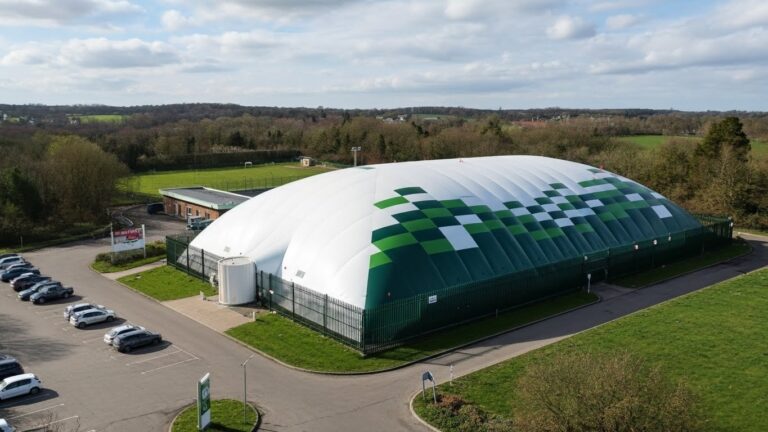
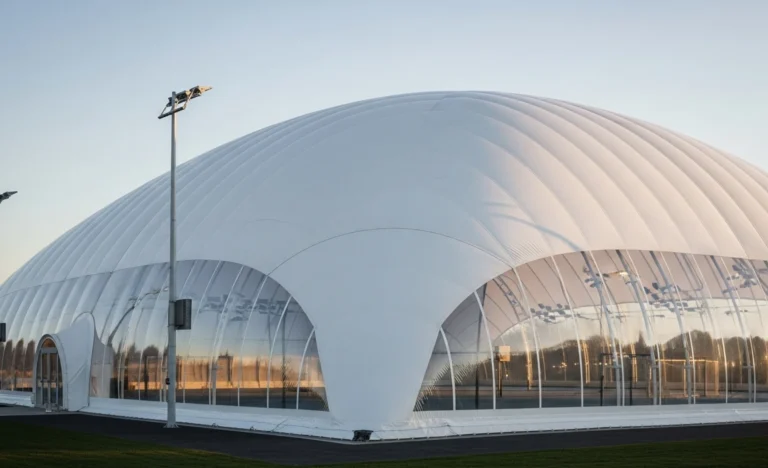
Air domes provide a pristine, all-weather surface for sports like soccer and football.
Environmental and performance considerations now form a standard part of approval and funding discussions. Strong proposals avoid vague claims of sustainability and instead demonstrate measured, responsible decision-making through energy strategy, daylight use, ventilation, operational efficiency, and lifecycle awareness. What builds confidence is not optimism, but evidence of considered trade-offs aligned with actual usage.
Stakeholder resistance rarely stems from opposition; it stems from surprise. Projects progress more smoothly when committees, neighbours, governors, and user groups are engaged early and transparently. Early dialogue allows concerns to be addressed before they harden into objections and strengthens internal confidence by demonstrating diligence and accountability.
Ultimately, the strongest cases rely on experience rather than hype. Precedent, comparable projects, and lessons learned from long-term operation provide reassurance that decisions are defensible not just today, but five or ten years into the future. Funding bodies and planners are not barriers to progress; they are safeguards against poorly framed decisions. When covered facilities are approached as strategic infrastructure investments grounded in need, benefit, and responsibility, approval is no longer something to fight for. It becomes the natural outcome of clarity.